We believe the decisive advances in noninvasive BCI will require a new physical interface—not another algorithm wrapped around a handheld probe.
01Origin
From neural computation back to the transducer.
Ambient was started from MIT computational neuroscience and mathematics, and Harvard electrical engineering and mathematics.
That combination led to a simple conclusion: if functional ultrasound is going to become a neural interface, the array, electronics, calibration, and reconstruction cannot remain separate products.
02Founders
The people accountable for it.
Ambient is early and deliberately small. You will work directly with the people building the hardware.
Baxter Barlow
Co-founderEmbedded systems · signal processing · neural decodingComputation and Cognition, Mathematics — MIT
Built the mmWave radar stack behind Ambient's first system: contactless respiration and heart-rate estimation from low-SNR returns, validated against reference instrumentation rather than demonstrated once.
Previously at the MIT Synthetic Neurobiology Group, working on AAV-delivered optogenetic circuits for targeted neuronal control, and on reinforcement-learning methods for protein design built over pretrained language models.
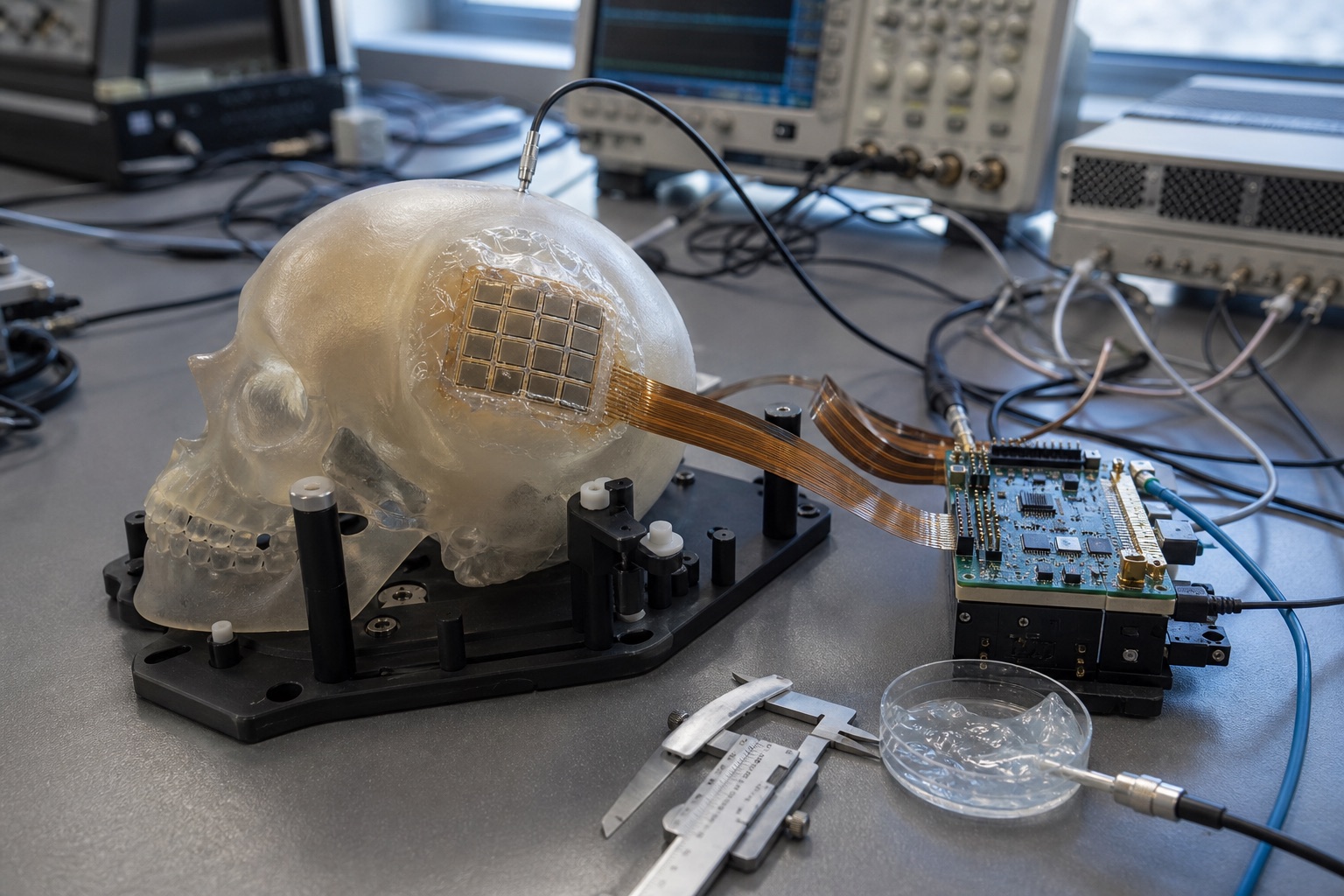
System-study image / conceptual bench configuration / not an Ambient build result
03The work
One tile. One skull path. One decisive measurement.
The first company milestone is deliberately physical: demonstrate useful transcranial information from a repeatable, head-compatible tile and learn exactly what the next aperture requires.
04Technical convictions
Three bets. Everything else is testable.
Architecture should become dogma only after the measurements make alternatives irrational.
01
Density changes the interface.
A distributed acoustic aperture can create repeatability and spatial access a held probe cannot.
02
Compute moves toward the array.
The right embedded data path makes dense ultrasound tractable without closing the experiment.
03
The system must know its own geometry.
Conformability only becomes useful when shape, contact, timing, and calibration move with it.