
The neural interface should be an aperture, not a probe.
Why the next generation of functional ultrasound begins with hardware designed around the head—not a scanner held against it.
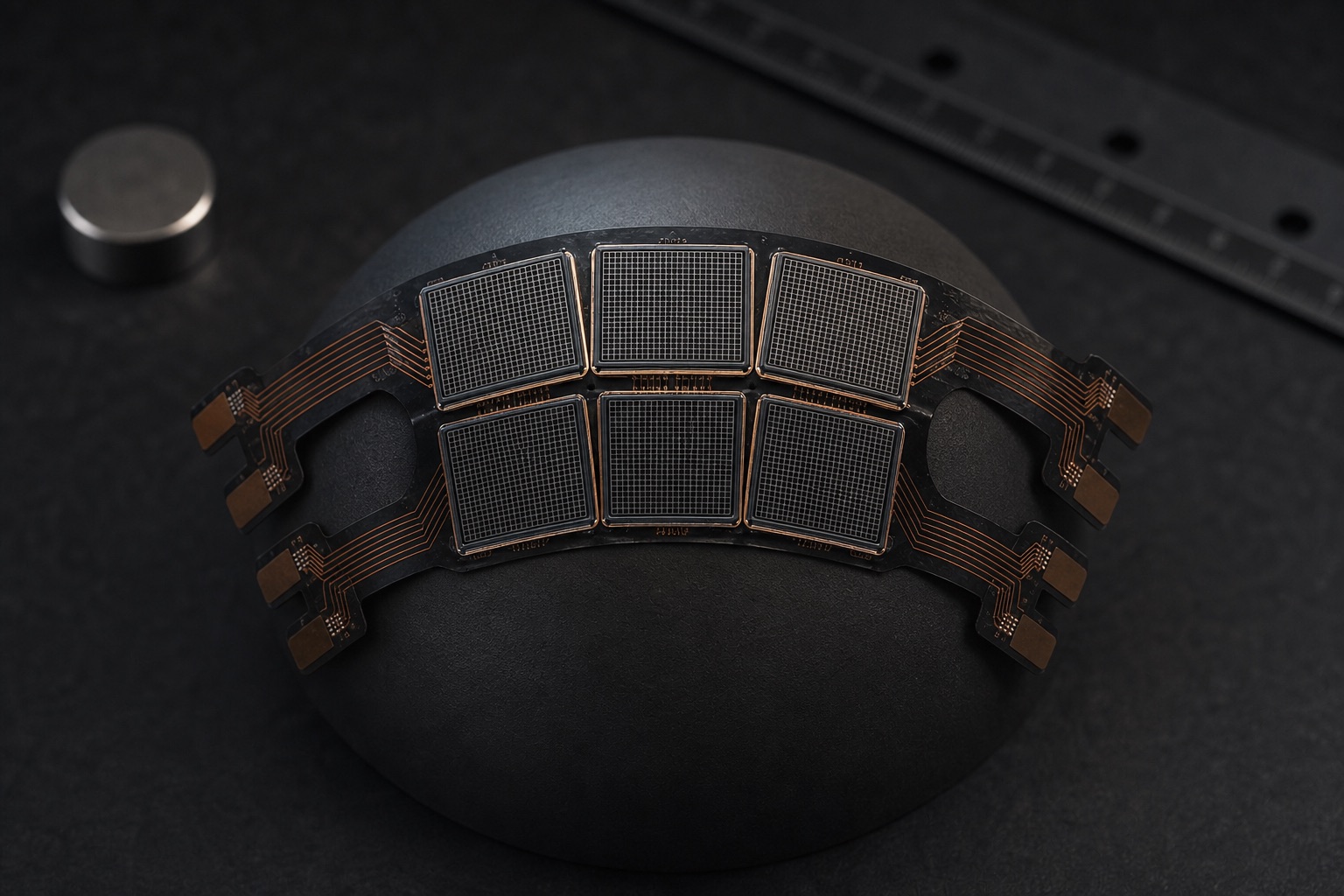
The probe is a temporary form factor
Clinical ultrasound was built around an expert moving one viewing surface across the body. A neural interface asks for something fundamentally different: stable placement, repeated geometry, continuous coupling, broad spatial coverage, and coherent access to the signal over time.
That shift changes the product from a handheld instrument into an aperture. Transducer geometry, embedded electronics, coupling, calibration, and reconstruction become one system rather than separate laboratory decisions.
A neuroprosthesis cannot depend on someone holding the sensor still.
The computation is already waiting
Ultrasound neurotechnology teams can now move from raw acquisition to sophisticated reconstruction and decoding with extraordinary speed. Their hardware still arrives as rigid probes, research consoles, large cable bundles, and coupling workflows that were never meant to disappear into a wearable device.
Ambient exists to close that gap. We are building networkable, skull-conformal array modules and the embedded signal path needed to operate them as one software-defined acoustic interface.
Start with the physical proof
The first milestone is not a whole-head rendering. It is a conformal module that can be placed, removed, and placed again while preserving useful signal better than a held probe. The second is coherent operation across two modules. Everything after that has to be earned by the measurements.