
Why we are not starting with a monolithic flexible film.
Conformability matters. So do acoustic pressure, receive sensitivity, yield, interconnect density, and a fabrication path that can survive contact with reality.
Flexible is a system property
A uniformly soft transducer sheet is visually compelling, but flexibility is not free. Polymer substrates can reduce transmit performance, complicate high-density routing, alter membrane behavior, and make element geometry move every time the device conforms.
For transcranial imaging, those compromises arrive on top of skull attenuation and aberration. A material choice that looks ideal on the head can be the wrong choice acoustically.
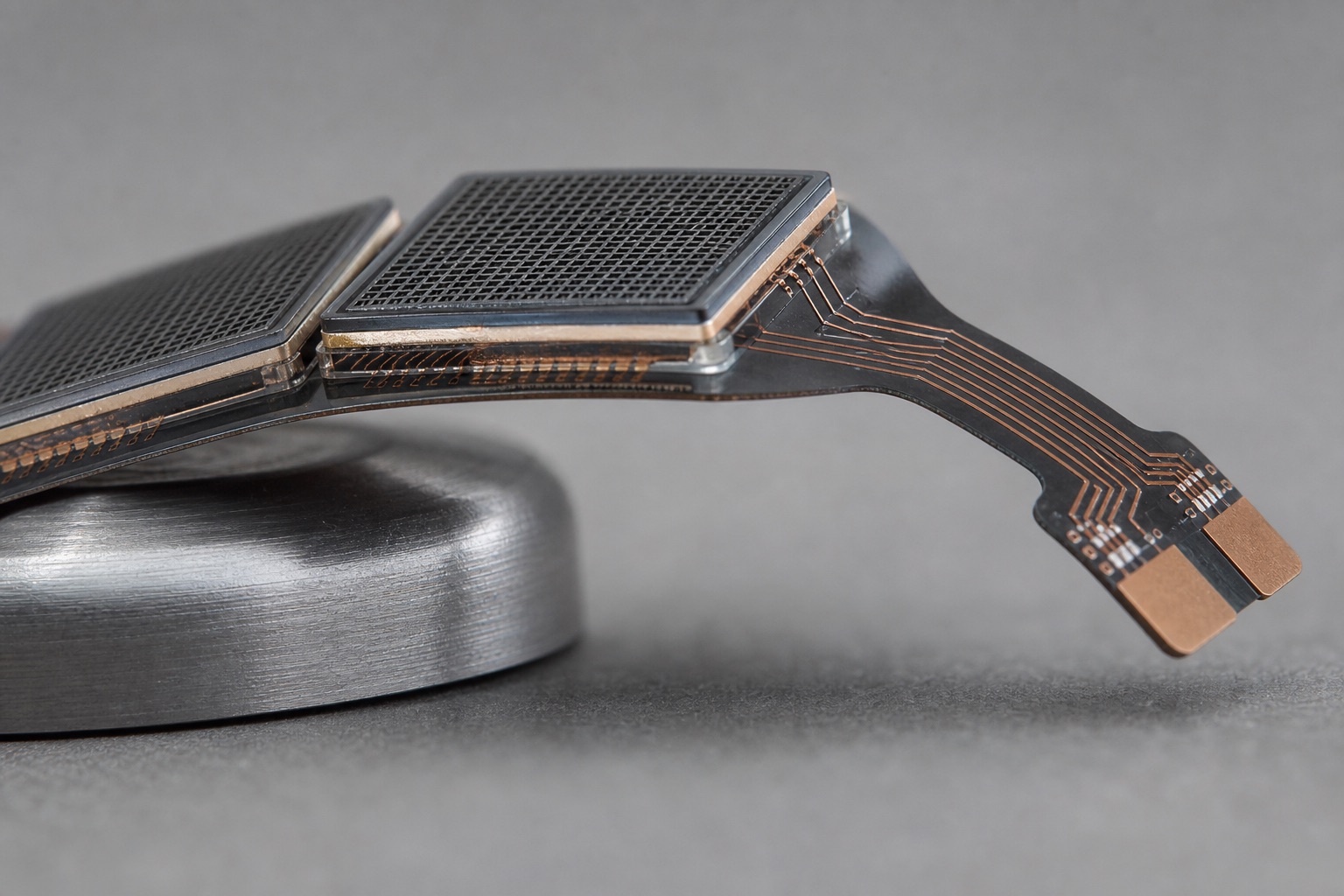
Rigid islands, compliant system
Our preferred starting architecture places high-performance transducer and electronics tiles on a compliant interposer. The complete aperture conforms even though the active islands remain dimensionally stable.
That makes it possible to test CMUT, pMUT, and piezocomposite implementations against the same system requirements. Ambient is neuroprosthesis-first—not religious about a transducer acronym.
The winning array may look more like a semiconductor mosaic than a sheet of fabric.
Calibration becomes part of the device
Once an aperture can bend, the system needs to know where every active region is. Shape, contact, pressure, and temperature are not secondary telemetry. They are inputs to coherent reconstruction.
That interaction between mechanics, geometry, signal access, and skull correction is where we believe a durable hardware advantage can be built.